
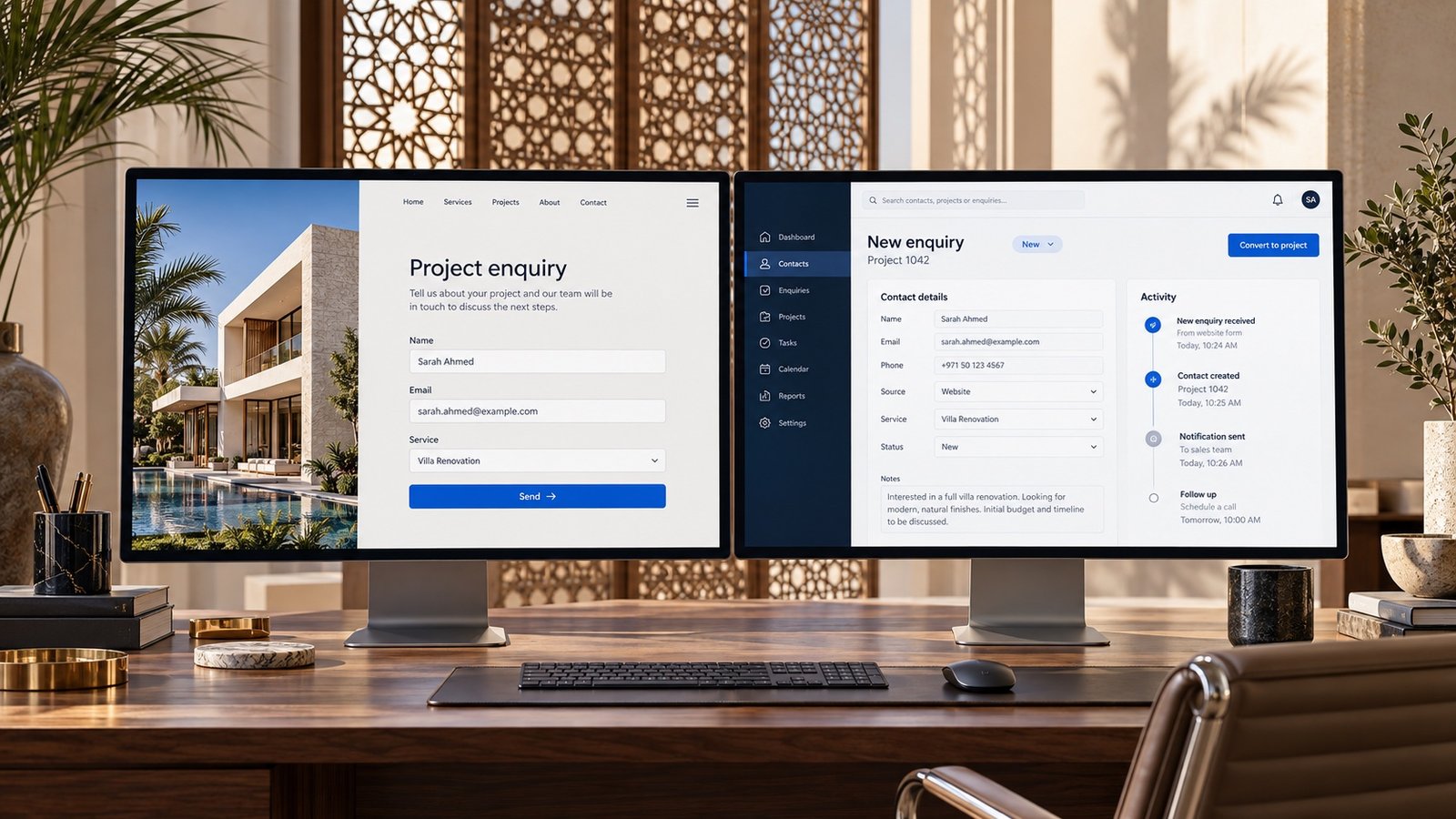
Website and CRM integration helps a UAE business connect marketing activity with the work its sales team actually does. A visitor submits an enquiry, a record reaches the right person and the eventual outcome can be traced back to the original request. Without that connection, more traffic may simply create a larger pile of unanswered messages.
This guide is for businesses serving customers across Dubai, Ajman, Sharjah and Abu Dhabi. It focuses on enquiry handling rather than treating every emirate as a separate copy of the same landing page. Your website should explain meaningful differences in service coverage while your CRM keeps the process consistent.
Design the minimum useful enquiry form
Ask for the information needed to begin a relevant conversation: name, contact details, requested service and a short description of the need. Add location only when it affects assignment or delivery. A project-based service may need an expected start date, while a product enquiry may need a model or quantity.
Keep required fields proportionate. Long forms can discourage a useful initial conversation, but a form asking only for a phone number may leave sales staff without enough context. Explain what happens after submission and provide a practical alternative contact method.
Agree on the record created in the CRM
- Source: the page and relevant campaign information associated with the enquiry.
- Request: the submitted service, location and message.
- Ownership: the team member responsible for the first response.
- Status: a clear starting state such as new or awaiting qualification.
- Next action: a task that can be reviewed and completed.
- Submission reference: a stable identifier to help investigate duplicates or delivery failures.
Use a defined rule for an existing contact who submits again. It may be a new project rather than a duplicate enquiry. Preserve the new request without overwriting valuable history or opening several identical records after a page refresh.
Handle failures without losing the enquiry
An integration should cope with temporary outages. Agree where submissions are stored, how failed deliveries are retried and who is alerted when a problem persists. Keep credentials on the server and restrict access to the systems that need them. Do not expose CRM secrets in browser code.
Test missing fields, invalid addresses, repeated submissions and a CRM timeout. Verify the result in the CRM itself, not only the success message on the website. If you send an acknowledgement, make sure it accurately describes the next step rather than promising a response time the team cannot maintain.
Match location pages to real service differences
A business offering remote software development across the UAE can describe that delivery model openly. A company offering physical installations should specify actual coverage and any site-visit arrangements. Avoid inventing local offices or repeating the same article with a city name swapped into every paragraph.
Connect relevant content to the service it supports. For example, an Ajman manufacturing guide should help a reader evaluate ERP workflows; a Dubai website guide should explain conversion and content decisions. Distinct buyer questions create more useful pages than a large collection of near-identical keyword pages.
Report from enquiry to outcome
Track submitted, assigned, contacted, qualified, won and lost enquiries using consistent definitions. Review unassigned records and overdue tasks regularly. Campaign and referrer data can be incomplete because of browser settings or consent choices, so avoid treating attribution reports as a perfect account of every customer's journey.
Separate traffic metrics from business results. An increase in visits is useful only in context: are relevant people enquiring, are requests reaching the right team and are conversations progressing? These are questions the connected system should help answer.
Can an existing website connect to an existing CRM?
Often, provided the CRM exposes a supported integration method and the website can submit securely. Review API access, rate limits, licensing and required fields before agreeing a fixed scope.
Should we automate every follow-up?
No. Automate reliable handoffs and reminders first. Keep human review for qualification, complex proposals and situations where an automated message would be misleading or unhelpful.
Plan a connected UAE enquiry system
Ultimate Solutions serves UAE businesses remotely from India. Explore our website development, CRM software and UAE service coverage. Share your current tools and enquiry workflow to discuss a scoped integration project.